Showing posts with label Nolan Art Gallery. Show all posts

26 October 2024

Painting an egg to see what hatches

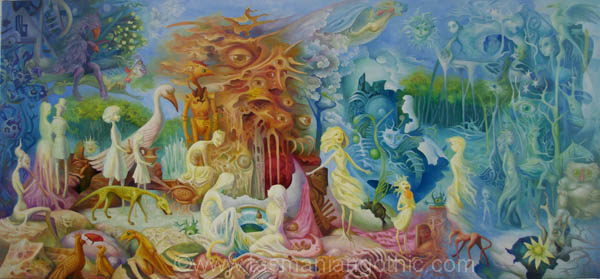
 HATCHING

Hatching oil on canvas 84 cm x 184 cm 

Laid perfect, smooth, fragile, mysterious, the immaculate egg is torn apart in a second birth and a new being emerges. This creature has some arrangement of feathers, skin, carapace, scales, legs, wings, fins, beak, teeth, mandibles, eyes, gills or pretty much anything else you can imagine. And that's just an ordinary egg. Once you get into its symbolic meaning you find everything from the creation of the Cosmos to a losing score in tennis.

If you are looking for symbolism there is plenty here – birds as messengers, embodied souls of the dead, symbols of light, peace, freedom and joy. An owl or two for darkness and wisdom. Ducks and chickens for domesticity and happiness. And, of course, the two famous questions: Why did the chicken cross the road? Why is a raven like a writing desk?

You may or may not find answers in this exhibition, but you will find plenty of eggs and poultry. And the odd – very odd – Raven.

Welcome to the world of bewildered Robot and encouraging Raven, reconstituted Thylacine, the terrifying Catcher, and a host of minor characters absorbed in their own esoteric activities and rituals. Animals and birds as beloved pet, exploited automaton, learned guide, fantasy companion. Watching over all is the enigmatic White Bird, which has appeared in several paintings in the past and will turn up again because I like it.

Help me explore the relationship between people and animals in a peculiar world that almost looks familiar, where the boundaries between animal, mineral and vegetable blur. A world of infinite potential where wonderful things could happen and meaning is whatever you make it.


On With The Show    oil on canvas 50 cm x 60 cm


Morning at the Dog Park    oil on canvas 61 cm x 75 cm


Off to the Races    oil on canvas 61 cm x 92 cm 


Pink Dress and Pussycat    oil on canvas board 50 cm x 60 cm


Catching the Egg    oil on canvas 102 cm x 66 cm 


Gift    oil on canvas 50 cm x 60 cm


Heggler    oil on canvas 61 cm x 45 cm


Fledglings    oil on canvas oil on canvas 50 cm x 60 cm


Ritual Birdbath     oil on canvas 75 cm x 60 cm 


Chickens in a Taxi    oil on canvas 122 cm x 91 cm 


Stone Chickens  oil on canvas  60 cm x 50 cm


Personally, the symbolism I'm going for here is creation, rebirth, optimism and joy. 

01 November 2023

A HALLOWEEN TALE


The Devil's head rests on a riverbank rock.

A precipitous path winds down the face of honeycombed cliffs. Unseen marsupials and mysterious serpents have left tracks in the sand where flesh-eating beasts retire to their lairs. Cockatoos the colour of death perch in dry branches. Through a break in the forest canopy far below you catch a glimpse of water. 

The rock wall to your left is eroded and crumbling. For millennia onslaughts of water and wind have weathered the soft, golden sandstone into extravagant caverns and hollows, creating a fantastic place of wonder. Shapes shift with the shadows, becoming faces, giant figures, impossible animals. 


Nature Walk - oil on canvas 91 cm x 122 cm

When you reach the valley floor it is cool and dark, a tangle of moss-covered boulders, fallen trees, hip-high ferns and trailing lichen, rotting logs, earth-stars and unfamiliar fungi. This is the Bluff River Gorge. Supernatural creatures, spirits of tree and river and rock, haunt this place.

I laid out my canvas on All Hallows Eve, when ancient beings emerge to commune with the owls and microbats and Tasmanian devils, and painted a picture of what I may have seen.

And the Devil's head? I found the little polished ivory skull once as I was crossing the river. After admiring it, I placed it back among the rocks in its bed of soft green moss. On my next visit, months later, skull and moss were gone, washed away in the winter floods.

*High quality limited edition prints of this painting may be ordered from Nolan Art Gallery, Salamanca Arts Centre, Hobart   https://www.nolanart.com.au/


29 September 2022

FLOCK an exhibition about animals

FLOCK is a joint exhibition of painting, sculpture and ceramics by Elizabeth Barsham, Betty Nolan and Rebecca Watson, three artists who love animals, opening on Friday 7th October, 2022 at Nolan Gallery, Level 1, Salamanca Arts Centre, Hobart. 

 Animals, or animal-like figures, frequently appear in my work, but I seldom paint pictures specifically about animals. 

When invited to exhibit in this show I was busy painting rocks and exploring industrial archaeology, but I did a painting of a unicorn especially. Then I managed to insert some teddy bears, sea monsters, birds, odd zoomorphic creatures and a stuffed elephant into the other pieces I was doing. 

 Here are the eight paintings I have finished. I'm working on another one with a wombat in it, but might not have it ready in time, so don't hold your breath. I'm sorry if you were expecting puppies and kittens.
Waiting for Instructions 61 cm x 91 cm
At the beginning of this year things seemed confusing and uncertain, what with a lingering pandemic, threats of war, family issues and all the other stuff that was going on. I rather wished there were some wise person who could tell us all what to do next. I feel this way at the beginning of most years and as usual there didn't seem to be any divine guidance forthcoming, so I did a painting instead.
Childhood Dream 82 cm x 66 cm
An adventure in ambiguous architecture. Toys for young and old and an infinite city.
Serenading a Unicorn 61 cm x 76 cm
Betty Nolan has been making gorgeous ceramic horses, and some of them turned into unicorns. I like unicorns, so I painted a few of my own. The Lady in whose lap the Unicorn should be resting its head has been upstaged by a crowd of unruly "musicians". She's not quite sure what to do about it.
Nesting Season 61 cm x 46 cm
There are striated pardelotes nesting under the roof of my studio, as happens about this time every year. It's a rowdy business building nests and raising chicks and they make a lot of noise. Meanwhile, fairy wrens are building their nests in the next-door shed where chicken wire across all the openings ensures they are safe from larger birds. I am not lonely!
Little Friends 30 cm x 61 cm
A happy little dream image, which may be the precursor to a larger painting. Meanwhile, think lollypops and sugar.
Hunting the Wild Agapanthus 84 cm x 91 cm
Agapanthus grow everywhere around my studio. I believe they are classed as weeds, and I would prefer native plants. But I enjoyed painting the flowers.
Conversation with a Pink Elephant 45 cm x 35 cm
A still-life study I did as a painting exercise. What more can I say?
Baby Kraken 45 cm x 61 cm
I found a rather boring picture painted about ten years ago abandoned in the back of my store-room. Added the Kraken, a definite improvement. Probably my favourite painting of all of these.


All these paintings are in oil on stretched canvas. If you are interested in any of them, contact Betty Nolan at Nolan Gallery, Space 109, Salamanca Arts Centre, 77 Salamanca Place, Hobart 
Phone: (03) 6223 3449 Mobile: 0438 446 785 
Gallery hours: Mon - Fri 10 am - 6 pm; Sat 10 am - 4 pm; Sun 12 pm - 4 pm

06 August 2022

Pink Flowers

a recent painting, now off to its new owner

When you venture into a Tasmanian forest you discover an intricacy of fungi, fern, lichen and moss, of strange little spiders, grubs and insects, of creatures avian and amphibious. Pause and watch them living their complicated lives around rocks, rivulets and rotting wood in an intriguing, interconnected wonderland. So much to keep you fascinated!

Pink Flowers oil on canvas, 84 cm x 97 cm

This is one of many paintings celebrating the intersection between flora and fauna in which I begin by painting some big, basic shapes to establish a pictorial scaffold. Then I grow the details over it, like buds opening on winter branches, green moss cushioning a delicate bone, the patterns of weathered rocks, networks of lichen lace draped over naked twigs; all these natural shapes begin to furnish and inhabit the space. Before long, they take on a life of their own and become a fantasy landscape, lush in colour, an improbable biology of anthropomorphic beasts and peripatetic vegetation.

The line

When fishes flew, and forests walked, and figs grew upon thorn . . .

repeated again and again in my head while I painted Pink Flowers and might go some way to explain it. I’m sorry about the unimaginative title, but I did put a bit of creativity into making the picture.

28 October 2021

Off to Exploit the Antipodes

In 1811 Governor Lachlan Macquarie, his wife Elizabeth and a sizeable entourage travelled from Hobart Town to Port Dalrymple on horseback. As Macquarie rode through the country he claimed the land by naming places after himself, his wife and his mates, erasing the ancient names used by people who already lived there. Here he is, leaving his official mark all over the landscape which, in this painting, is loosely based on the route of the old bush road through an area locally known today as Murderers Gully.

The Governor Rides By    61 cm x 77 cm
These paintings are about the colonial takeover of Trouwunna, as seen from a safe distance. 

They were first exhibited in Understory, an exhibition at Nolan Art Gallery in Salamanca Place, Hobart, in November 2021.

Throughout my life the narrative of Tasmania’s indigenous people has been told and retold, changing from a tale of the regrettable annihilation of a “dying race” (neatly culminating in the death of the “last Tasmanian”), to the reclamation of cultural identity by the Palawa. As the descendant of convicts who arrived in the first British ships, I realise many of my ancestors were complicit in the colonial genocide. The question is how to deal with this knowledge.

As usual when confronted by something too complicated, I retreated to my studio to explore the issue in paint.

The result is a series of large, complex images intended to intrigue and disturb viewers. The playful beauty of these oil paintings, with their humorous characters and seductive colour doesn’t quite obscure the darkness and violence of the subject matter. Expect anthropomorphic forests infested by inchoate, chthonic figures and strange encounters with the all too present inhabitants of “Terra Nullius” as the colonisers set about the business of exploiting the antipodes.


According to various history books, Tasmania was discovered on the 24th November, 1642, by Commodore Abel Jansz Tasman.

Discovering Terra Nullius    138 cm x 123 cm


When Tasman sailed down the coast of Trouwunna in 1642 he didn’t see any occupants, but saw certain indications that the place was inhabited. Cook, Baudin and other early visitors confirmed this, but persisted in declaring that they had “discovered” a new country that was up for grabs. The people who had already discovered the place and made it their home tens of thousands of years earlier were not asked their opinion. 

All the Pretty Ships Came In   91 cm x 122 cm

There are varying accounts of how astonished Australians were when the first European ships arrived. Were these strange things huge seabirds, or floating islands with possum-like creatures running up and down the trees? How did they move, with nobody pushing? Did they walk along the bottom, or paddle like swans? Eventually the ships came in and these problems were solved, but they were exceedingly trivial compared to what followed.

The British assumed, as usual, that they could move in and take over. 

Off to Exploit the Antipodes   152 cm x 122 cm

If the locals were nonplussed by the new arrivals, the colonists were rather apprehensive about unknown horrors inhabiting the jungle into which they had been thrust.

The Wild Woods   91 cm x 122 cm

Many of them knew little of the world beyond a few city streets or a couple of rural villages, their education consisting of superstition and local gossip. The forests of Van Diemens Land must have been pretty fearsome. 

The tough ones survived. We don’t know much about the ones who didn’t. 

Into the Hinterland   87 cm x 117 cm


 Do you watch horror movies? Do you ever wonder what it would look like if the zombies won? And they made the movie?

Arthur and the Zombie Apocalypse   84 cm x  183 cm


Governor Arthur’s futile, but no doubt terrifying, Black Line failed to capture any of the “troublesome natives”, but helped convince the few remaining people that their only option was to accept George Augustus Robinson’s proposal to move them to Flinders Island.

It didn't end well.

Tiny Tragedy   91 cm x 76 cm

05 July 2020

When the Tide Goes Out

When the Tide Goes Out    oil on canvas   92 cm x 112 cm

What do you find when the tide goes out? Abandoned fishing nets are ubiquitous, and I've found pretty much everything in this painting on a seashore somewhere. Except the mermaid. I haven't found a mermaid. I really don't want to.
Mermaids are the ultimate Dangerous Women, luring poor randy little innocent sailor-boys to their doom or something. When I was in primary school we learnt a sea shanty that was popular among sailors in the seventeenth century, if not earlier. It describes a Mermaid sitting on a rock “with a comb and a glass in her hand”, an image you can find in fourteenth century manuscripts, so it's been around for a long time.
Seeing what is happening to the oceans, I reckon these days she'd be angrier and a lot nastier than the most degenerate old salt could imagine.

But what if she's moved with the times? What if she's traded her mirror for the current symbol of vanity – the phone, and amuses herself taking selfies, sexting her victims and enthusiastically spreading mayhem, disinformation and confusion on social media? Don't imagine for a moment that a twenty-first century mermaid is a cute, sanitised fishy Disney Princess.
And really, really, hope you don't meet one when the tide goes out.

You can see this painting and the two below in the Dangerous Women exhibition at the Nolan Gallery, Salamanca Arts Centre, Hobart until at least the end of July 2020
If you want to hear a lively version of the sea shanty, here's a link
https://www.youtube.com/watch?v=1HiReDV9FAA

Balancing on the Edge - oil on canvas 50 cm x 40 cm

Our Lady of Disorderly Conduct  oil on canvas 50cm x 40cm
Some say the popular Mediaeval new year Feast of Fools began in pagan Rome to welcome the returning light after mid-winter. The Lord of Misrule turned the hierarchy on its head, jesters reigned; kings served. Beggars rode; lords grovelled. Everyone dressed extravagantly, danced and sang and disrupted church services, children demanded treats. All was rowdiness and revelry. Then, having let off steam, they returned to their daily lives of drudgery, piety and obedience.
Artists are today's Lords and Ladies of Misrule, creators of glorious anarchy, enlivening everyday reality with intrigue, excitement and joy.

Enjoy!

More King Island Gothic paintings:
Shane's Grassy Oppy
Return to the Island
King Island Gothic


24 July 2018

HAUNTED LANDSCAPE

Haunted Landscape is a carefully selected collection of paintings about landscape, memory, and the passage of time. These paintings were exhibited at Nolan Art Gallery in Salamanca Place, Hobart, between 21 July and 14 August 2018. You do not have to agree with my commentary; bring your own experiences and interpretations, but above all, don't take them too seriously. Relax and enjoy!

Following the Van - 66 cm x 112 cm oil on canvas

FOLLOWING THE VAN

Is that an actual mountain? Somebody asked. I had to say “no – I made it up”.
I spend a lot of time walking in landscape, looking at landscape, and occasionally recording a piece of its history, often illustrated with photographs I have taken.
The infinite variety of shapes, texture and colour in the Tasmanian bush provides me with endless inspiration, but when it comes to painting I am not interested in recording an accurate image of a specific feature. My paintings are about ideas. Landscapes provide the stage and help set the mood of the picture and I adjust and modify them freely to fit my needs, working from memory but occasionally referring to a photograph for an odd detail.
The people I walk with are never as strange as these, and so far the landscape has never been so desolate. The caravan has moved on, and the stragglers are left behind.

McCrae's Hill - 91 cm x 76 cm oil on canvas

McCRAE'S HILL

In the early nineteenth century Mr McCrae and his wife took up land near the foot of the Western Tiers. They built a standard Georgian farmhouse; the front rooms red brick; the back, over the brick-lined cellars, were timber. Perhaps the intention was to rebuild in brick once land was cleared and money came in from crops and livestock.
Decades passed. Properties changed hands, new roads were formed. McCrae's Hill, a low rise surrounded by swamp, was marooned far from commonly travelled paths. In the twentieth century the old house was abandoned in favour of a new home convenient to the road. Now great trees that once shaded a colonial garden lie rotting across the path. The head of a broken windmill hangs upside down over a rusty tank. Timbers have rotted away. There are gaping holes in the wall where bricks have crumbled, floors and staircase are treacherous, the stone lintel fallen onto the steps below. Nature, season by season, reclaims its own.

Among The Fallen - 66 cm x 97 cm oil on canvas

AMONG THE FALLEN

There is a historic cemetery in Richmond, behind Australia's oldest church. Below it flows the Coal River, where a platypus may occasionally be glimpsed at sunset.
My friend and I walked, after a scenic drive and cream tea, among the crooked headstones, reading names of other people's ancestors. The hill is steep, the grass was wet, and my friend slipped and fell. It was not a serious fall, but she has back trouble and was in a lot of pain. It was a few moments before she let me help her up, and we made jokes about fallen women. She wore a pale coloured coat; I was in my customary black. By the time we reached home all these images had begun to form a picture, and this is what it became. We didn't see a platypus that day, but I thought a thylacine was more appropriate. After all, we didn't see one of them, either.

Settlement Day - 66 cm x 97 cm oil on canvas

SETTLEMENT DAY

The idea for this painting fermented in the back of my mind for many years, bubbling to the surface now and then, until I decided it was probably ready. A lot of preparatory drawings were rejected or, in some cases, re-purposed to appear in other paintings.
Tasmanians are regularly reminded that we are descended from invaders who stole the land; in fact, you'd be hard-pressed to find a country anywhere that hadn't, at some time, suffered an invasion. Here is a happy farm in a pretty valley, loosely based on a property I visited on the Clyde River near Hollow Tree. A dark force is approaching; this does not augur well.
I particularly enjoyed painting the sheep. Sheep are cute, warm, woolly, slightly demented (by human standards) and incredibly useful. They have completely changed the landscape, nibbling vegetation to its roots, compacting the soil and churning up mud with their sharp little hooves. Native bushland is turned into pasture to accommodate them. Some people call this deplorable environmental damage. Other people call it economic development. Anyway, here they are, a vital component of rural industry or ravenous little beasts intent on destruction.
The phrase “settlement day” has at least three different meanings – invasion, retribution or debt collection. Take your pick. If you think of another one, let me know.

Laughing Girl - 76 cm x 61 cm oil on canvas

LAUGHING GIRL

This is a painting “of” three figures based on an old family photograph, and a distinctive feature on the Clyde River near Hollow Tree, but that is not what it is “about”.
It is about landscape and the memory of people who have passed through it. As future becomes present and fades into yesterday, only memories remain. A thousand generations have left their memories on this country; I am qualified to address only those arriving since the end of the eighteenth century. The characters in my paintings are no more sad, happy, benign or malicious than people you meet every day, nor are they lost souls. They are part of the land and its history.

Bones of the Ancestors - 76 cm x 152 cm oil on canvas

BONES OF THE ANCESTORS

Everywhere we go, we find traces of people who went before us. “Bones” in this context include any skeletal structure, be it metal, masonry or timber. Anything that endures after the soft bits are gone. I have even extended it to include earthworks, ruined forests and colonial history. That might be stretching it a bit, but it's my painting and I make the rules.
Wherever you get interesting ruins (and a successful marketing strategy) you get tourists as well. I have painted about them in the past, and will have more to say in future paintings.

A Child's Guide to Wilderness - 84 cm x 91 cm oil on canvas

CHILD'S GUIDE TO WILDERNESS

This painting is about the present, and more easily explained in dot points. Interpret them as you will.
  • we live in an increasingly urban environment and many people rarely experience bushland or natural places. They run on treadmills, climb indoor walls and inhabit virtual landscapes where they can farm or fight as they please
  • nature has become a theme park, where the wealthy go to play on their holidays while David Attenborough shows the pretty bits to people who can't afford holidays
  • “wilderness” is a modern construct; there is no such thing as a pristine landscape, especially in Australia where it has been carefully managed for thousands of years. “Wild” simply means “neglected”
  • we are increasingly spreading plastic and other pollutants all over the country and ocean, to the detriment of the non-human people trying to share the natural world with us
  • does it matter?