25 September 2013

Bluff River Gorge

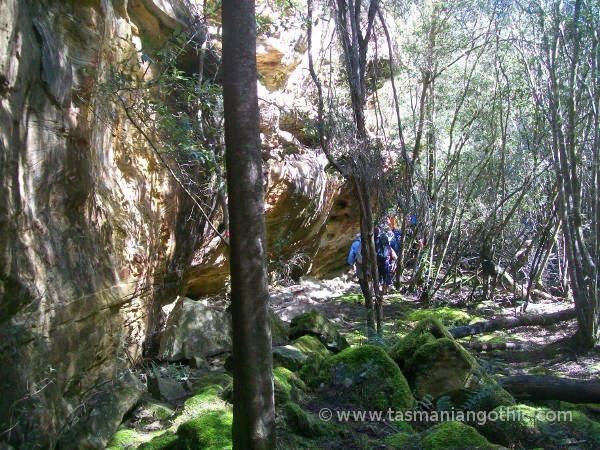
Bluff River Gorge is one of Tasmania's best-kept secrets - unless you're a bushwalker. I've walked in there several times, but today was the first time I remembered to take a camera. These are the results.
Morning tea before tackling The Gorge

Et in Arcadia Ego

and this is where it fell from . . . 
It's a bit of a hike to the top of the gorge, a steep path down towards the Bluff River, then a nerve-wracking traverse along the gorge. And it's worth every minute, alternating between awesome and aaaagh, depending on whether you look up at the incredible sandstone formations or down at the sheer drop to the Bluff River, far below.


 I would have taken more photographs, but in most of the really spectacular places I was too busy hanging on like grim death to pull out my camera. It is not a particularly difficult walk, but there are plenty of places where the path is the width of your boot, loose sand or slippery moss, and there's not much between the walker and the water far below.


the river far below


 The day was fine until lunchtime when we were hit by a violent squall that sent everyone scrambling into their foul weather gear. As soon as we set out again the sun reappeared so we stopped to take our jackets off again. Tasmania has such humorous weather.

 We scrambled over and under fallen trees down to the river, hoping to walk back along the other side of the gorge. "Why are we going this way, if it's further than the direct route back to the cars?" a Prospective Member asked. Because we're a walking club - it's what we do . . .

 The river is not very wide, but it was flowing very fast and the stepping stones were submerged boot-top deep. There was some discussion about whether we should cross, but the day was finally won by those who were not in the mood for wet feet, and apprehensive about the second crossing we would have to make further downstream. We turned back.

to cross, or not to cross?


along the bottom of the gorge


Now things got a bit confusing. Some people who were well ahead missed the turnoff up the hill. There was a good deal of coo-eeing echoing up and down the gorge, with half the walkers waiting at Octopus Head, where we'd stopped for lunch earlier, and the rest climbing the next spur and following a fire trail back in the right general direction.

Coo-ee - where are you?

reunion

It didn't take long to make contact and establish where they were and we assured the Prospective Members that losing half the group was not a usual occurrence. They didn't look too worried.


We returned to the cars tired but happy and the day ended with the usual picnic. Thank you to the walk leader!

22 September 2013

Saturday in Hobart

One of my favourite pastimes is playing tourist. And one of the things I love about Hobart is that I don't even have to leave home to do it! Take today, for instance.

First I had to go to work, teaching my regular Saturday drawing lesson. As it was a nice day we spent a couple of hours outside in Princes Park.
drawing in Princes Park

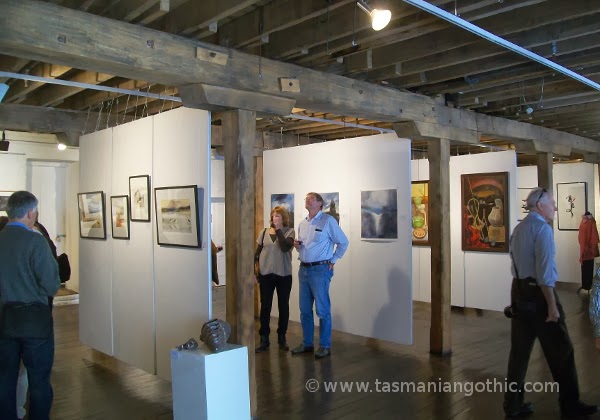
Back at the Salamanca Arts Centre I found 40 Artists from the Island, an exhibition of paintings, drawings, prints, sculpture, textiles, assemblages and more, opening at the Long Gallery. This is one part of Rediscover Bruny, a three-part showcase of Bruny Island arts. It seems practically every artist I meet these days lives on Bruny, or at least has a holiday house there, and this event has almost a hundred participants – not bad, when you consider there are only seven hundred people living on the island.

Of course, they are not all visual artists. In the Sidespace Gallery beside the Long Gallery there is a charming exhibition of Childhood Treasures, precious items people have kept for most of their lives: teddy bear, puppet, building blocks, favourite books, each with an explanation by its owner telling us just what makes this particular toy so special.


40 Artists from the Island opens in the Long Gallery
The third part of the Bruny Island spectacular is As Time Goes By, written by Barry Weston and directed by Megan Weston, a theatre piece "written, directed and performed by Bruny Islanders for Bruny Islanders and about Bruny Islanders”, which played in the Peacock Theatre on 20th and 21st September. 

I was really impressed by the overall quality of the artwork in the main exhibition – some truly lovely work, and I took my time enjoying it, along with a glass of white wine and some super Bruny Island cheese.

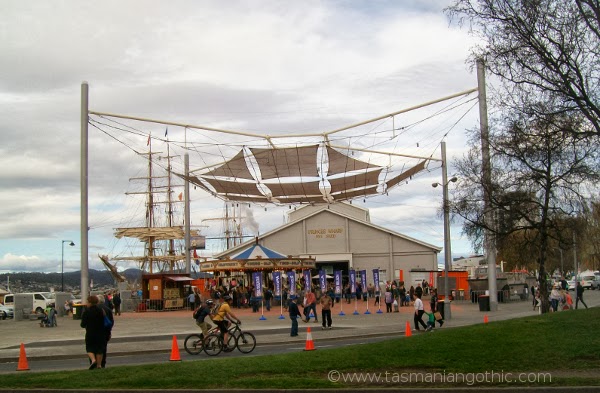
Tall ships, a carousel,  live music, terrific food . . . 
Returning to the sunshine outdoors I wandered through Salamanca Market to the Tall Ships Festival. Lunched on a delicious goatmeat-and-elderberry-wine pie at Princes Pier, tried some apple, pear and cherry cider (more, please!) and strolled round listening to musicians, admiring ships and generally enjoying the atmosphere. Here are some of the things I saw.


This wonderful steam carousel, complete with calliope to provide music, always brings a lump to my throat, and true to form I had a little Stendhal Moment in front of it today.


Europa's figurehead caused some comment.
This old Greek tale of woe should serve as warning to all
young ladies not to believe that bull . . .


Is this the youngest jazz band in town? They played very well.


Of course, Preana isn't a tall ship, but she's so pretty another photo
of her doesn't hurt. And there's a real Tall Ship there, too.

Lots of history here at Constitution Dock - some of Australia's
oldest wooden boats and the old Customs House

The Vikings are back!


It was time to return to the car and head for home. Stopped for a while on the lawns of Parliament House to listen to the Hobart Old Time String Band along the way.


By now the market was closed and stall-holders were packing up.


The sky was beginning to cloud over. I made it home just before a brief shower of drizzly rain, tired but happy. Who wouldn't love this place?

just a little corner of  our garden

21 June 2013

The List of Lost Things

We all lose things - pens, car keys, pets; some things leave bigger holes in our lives than others. What happened to things we lost many years ago? Where are now? It was a small step from there to thinking about being Lost in the Bush, which is not a very ancient phenomenon. Almost every year somebody disappears without trace into our wilderness.

In the early days Tasmania, off on the opposite side of the world, was a strange and alien place for Europeans  and those sent there really were lost to their friends and family. We know what happened to many of them. Life on the island, in its mountains and forests, changed them into something their families may not have cared to recognise. For better or worse they became something different. They became Tasmanians. And they began to tell their own histories.

Some of the tales are well known. Some of the events really happened, but are not particularly well known. And some of them I just made up. But I'm not going to tell you which is which.

Missing Children

Missing Children; acrylic on paper; 24cm x 17cm


 Australian literature is full of tales of children lost in the bush. Most of them are tragic, verging on sentimental. But what if . . .

Some children might not be lost at all. Some of them might be perfectly happy growing up feral. Parents might not want some of them back once they discovered what they had become . . .


Mrs McCrae's Husband

Mrs McCrae's Husband  - acrylic on paper; 24cm x 17cm

The McCrae family arrived in Tasmania early in the nineteenth century, taking up a land grant in the Bracknell area, close to the foot of the Western Tiers. They built a brick farmhouse in the accepted Georgian style on a low hill in the scrub, called it McCrae's Hill, and settled down to farming. They were probably happy there. 

One evening they were sitting by the fire when there was a knock at the door. Mr McCrae went to answer it, came back to his wife to tell her he was going out for about ten minutes - and was never seen again. Well, that's not quite true. They found his body stuffed in a hollow log some days later. Nobody ever found out who, why or anything else. 

But what of Mrs McCrae - what did she think had happened? How soon did she begin to worry - after ten minutes, an hour, next morning? What did she do? I don't know. But the ruins of the farm house are still there, and if they aren't haunted, they should be.


The British Soldier

The British Soldier - acrylic on paper; 24cm x 17cm


It is said that a couple of centuries ago a soldier became separated from his patrol when bad weather closed in somewhere on the foothills of Mt Wellington . . . His companions returned to barracks battered, wet and weary long after nightfall. Perhaps search parties were sent out when the weather cleared; but the missing man was never found.

To this day he wanders, still forlornly seeking the way back to his barracks, scrambling up rocky outcrops and over scree slopes, becoming more and more part of the alpine landscape. And from time to time on wild, wet, windy nights when sensible people stay home by the fire, a traveller on the Huon Rd catches a fleeting glimpse of a spectral horseman in red disappearing into the forest . . .

The List of Lost Things is a series of small paintings based on Tasmanian legends and tales from the bush. It is an ongoing project and more images will be added as I paint them.

25 April 2013

North, to Alaska - or, things I found in the garage


Back in the early 1970's my father bought a huge old derelict house in Macquarie Street. It had been empty for years, but there was still a lot of stuff left by its previous owners, the Stump family. Of course, it has all been hoarded in the back of our garage.

There are some interesting documents for me to go through one day (so far I've found quite a lot of legalese dealing with a stolen cow), some very nice family photographs (as if I need photographs of somebody else's family!) - and these two gems.

This has, neatly handwritten on the back, the inscription: "S.H. Yeomans in Indian Attire. 10.00 prize money rec. for Decorations".  It is dated July 4 1908. Skagway celebrates Independence Day. Unfortunately I can't read the
placard leaning against the wall behind the gentlemen on the left, other than the words AND IS AGAINST.
I'll probably never know what they WERE AGAINST. 
What the stylish young lady drives around Skagway . . . Mr Yeomans' Curio Store, Skagway, Alaska.
The handwritten inscription on the back of the photograph says "S.H. Yeomans Clerk of Year 1907"
 and the year 1907 has been written in ink below the caption at the bottom of the photograph.
About 1889 Mr Stanton H. Yeomans closed his barber shop in Whitesville, Allegany County, N.Y. and headed for the Big Smoke – New York City. He stayed there for a few years, becoming “one of the greatest checker players of the country,” but in July 1897 the steamship Portland arrived in Seattle with, as the Seattle Post-Intelligencer announced excitedly, “more that a ton of solid gold on board”. For once the hyperbole turned out to be understatement – two tons of gold were unloaded from the Portland. At any rate, this sparked the famous Klondike gold rush, and Mr Stanton Yeomans wasn't going to be left out.

He headed north to Alaska to seek his fortune and staked a claim, but had to continue working, under pretty primitive conditions, at his day-job for a bit longer. This was obviously not his favourite occupation for he soon sold his barber business, bought some horses and began packing stores over five miles of mountain, probably on the infamous “Dead Horse Trail” over White Pass. He lasted for one winter, and claimed that the struggle to keep his animals alive turned his hair grey.

Mr S.H. Yeomans in Indian Attire.
We are not told what the Indians thought about it all
Eventually he was able to work his Spruce Creek goldmine, but seems to have realised pretty quickly there are easier ways to make money on a goldfield. He went into business in Skagway, the “gateway to the goldfields”, a thoroughly up-to-date settlement “with churches, schools, electric lights, water system, etc.” and a population of 1,300. He was soon running “three stores and . . . making big money”. In 1904 he visited his old friends in Whitesville, showing off his “watch chain made of thirty-five gold nuggets which is worth about $40” and “some other fine specimens of gold”.

It's lucky for me he made this visit as The Whitesville News published an account of it on Thursday, March 10, 1904 and that's what I'm quoting here.

The successful Mr Yeomans returned to Skagway, and we've got the photos to prove it.


That's not a dog in the foreground.
According to the decorative banner  it is an "Alaskan wolf trained and tamed by S.H. Yeomans, dealer in Indian Curios"

I'd guess Mr Yeomans used them to promote his business interests – but South Hobart is a long, long way from Skagway. How did they get here?
Had the Stumps a family connection with Mr S.H. Yeomans? Or were these just popular mass-produced photographs people bought to decorate their homes? I've no idea. But I think I'll keep them, anyway.


Some of Mr Yeomans' window display

Update 

6 October, 2017


A few weeks ago I received an email from Peter Bennison whose wife Julie is descended from the Stump family.

Henry Stump owned several properties in South Hobart. In 1873 he married Mary Rawlinson  and they had nine children. Of these, Fergus became Julie's grandfather. Maud's daughter married my great-uncle (who was the youngest of a big family, and the same age as my father). Elsie and Rosetta (Etta) also married, and moved to New Zealand and Melbourne respectively. Alfred became a farmer at Granton; Garnet eventually moved to Wollongong. Fanny and Maria lived out their days in the old house decaying quietly in Macquarie St. And Ella, the eldest in the family, married Mr Stanton Yeomans of Skagway, Alaska. That's her in the dog-cart above.

Julie and Peter were on a cruise, calling in to Skagway, and an internet search for Julie's great-uncle turned up my blog entry. We have now met up over coffee. The photos that turned out to be of Julie's grandparents and aunts have been returned to their rightful family. These photos will soon be on their way to the US National Parks Service Museum in Skagway, Alaska where Mr Yeomans once lived with Miss Ella Stump (as was) from Hobart, Tasmania.